

A Defining Moment in European Security
UK Prime Minister Keir Starmer has positioned himself as a central figure in the effort to end the war in Ukraine, unveiling a four-point plan that seeks to forge a strong European front while urging the United States to play a decisive role. His initiative, dubbed the “coalition of the willing,” signals a shift in European security dynamics, emphasizing a proactive stance against Russian aggression.
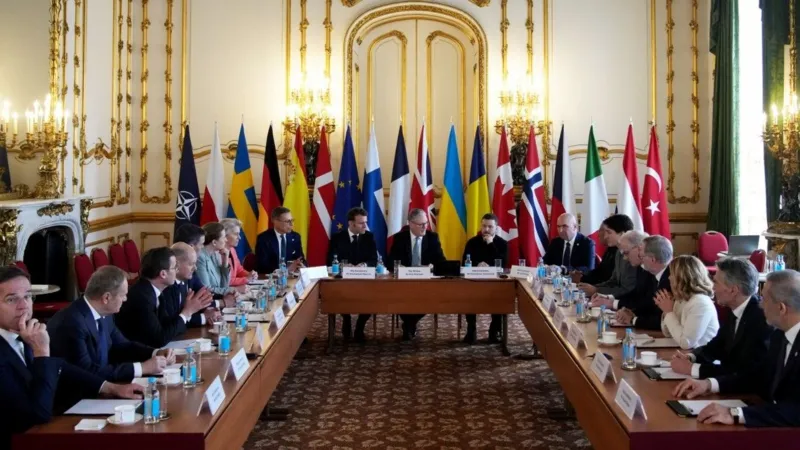
The announcement came after an 18-nation summit attended by key European leaders and Ukrainian President Volodymyr Zelensky. Starmer’s plan underscores a critical moment in history, where the West faces mounting pressure to ensure Ukraine’s security without succumbing to weak diplomatic compromises that could embolden Russia.
The Four Pillars of Starmer’s Plan
Starmer outlined four crucial elements in his vision for securing Ukraine’s future:
- Sustained Military and Economic Pressure on Russia – Continued military aid to Ukraine remains a priority, coupled with increased economic sanctions to weaken Moscow’s war machinery.
- Ukraine’s Sovereignty as a Non-Negotiable Principle – Any peace agreement must guarantee Ukraine’s territorial integrity, ensuring that Kyiv is a key participant in future negotiations.
- Strengthening Ukraine’s Defense Capabilities – In the event of a peace deal, Ukraine must be armed adequately to deter any future Russian incursions.
- Building a Committed Coalition – A strategic alliance of willing nations will be established to uphold peace and prevent a repeat of Russian aggression.
To reinforce these commitments, the UK pledged an additional £1.6 billion ($2 billion) in export finance to supply Ukraine with over 5,000 air defense missiles, supplementing a £2.2 billion loan backed by profits from frozen Russian assets.
A Europe-Led Initiative—But Can the U.S. Be Persuaded?
A major concern for European leaders is the role of the United States under Donald Trump. The summit occurred just days after a tense confrontation between Zelensky and Trump at the White House, where the U.S. president accused Ukraine of “gambling with World War Three.” Trump’s approach—marked by skepticism toward Kyiv and overtures to Russian President Vladimir Putin—has left European allies wary of Washington’s commitment.
Despite Trump’s reluctance, Starmer remains diplomatic, stating that the UK and Europe agree with the U.S. on the need for a “durable peace” and must find a way to collaborate. However, the reality is that the U.S. has already begun backchannel peace talks with Russia—excluding Ukraine, a move that many European leaders view with deep concern.
Strategic Implications for Ukraine and Global Politics
Beyond military and diplomatic maneuvers, Ukraine is also negotiating a critical mineral deal with the U.S., granting American access to its rare earth reserves. The agreement, initially set to be signed in Washington, was delayed following the tense Trump-Zelensky meeting. U.S. Treasury Secretary Scott Bessent has since hinted that any mineral agreement is contingent on a peace deal with Russia—another indication of Washington’s evolving priorities.
European Commission President Ursula von der Leyen has reinforced the urgency of “re-arming Europe” to counterbalance any wavering U.S. stance. NATO Secretary General Mark Rutte echoed these concerns, urging European nations to step up their efforts to ensure Ukraine has the necessary military and economic support to withstand prolonged conflict.
The Path Forward: A Europe Taking Charge?
As Starmer forges ahead with his coalition, the geopolitical landscape is shifting toward a Europe that is no longer waiting for American leadership. The UK, France, and other nations are preparing to “do the heavy lifting,” but the looming question remains: Will the U.S. ultimately support this effort, or will Trump’s approach weaken Western unity?
The coming months will be pivotal in determining whether Starmer’s vision translates into tangible action or remains an ambitious yet unrealized initiative. With Ukraine’s future—and Europe’s security—hanging in the balance, the world watches as history unfolds.